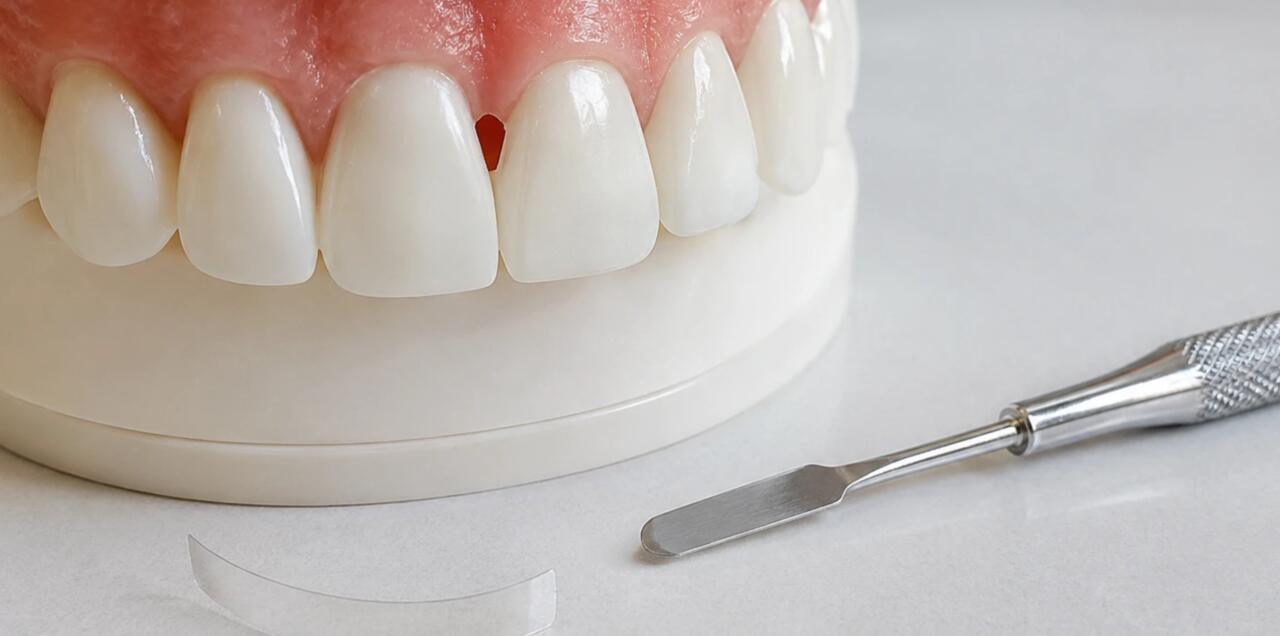
What a black triangle is
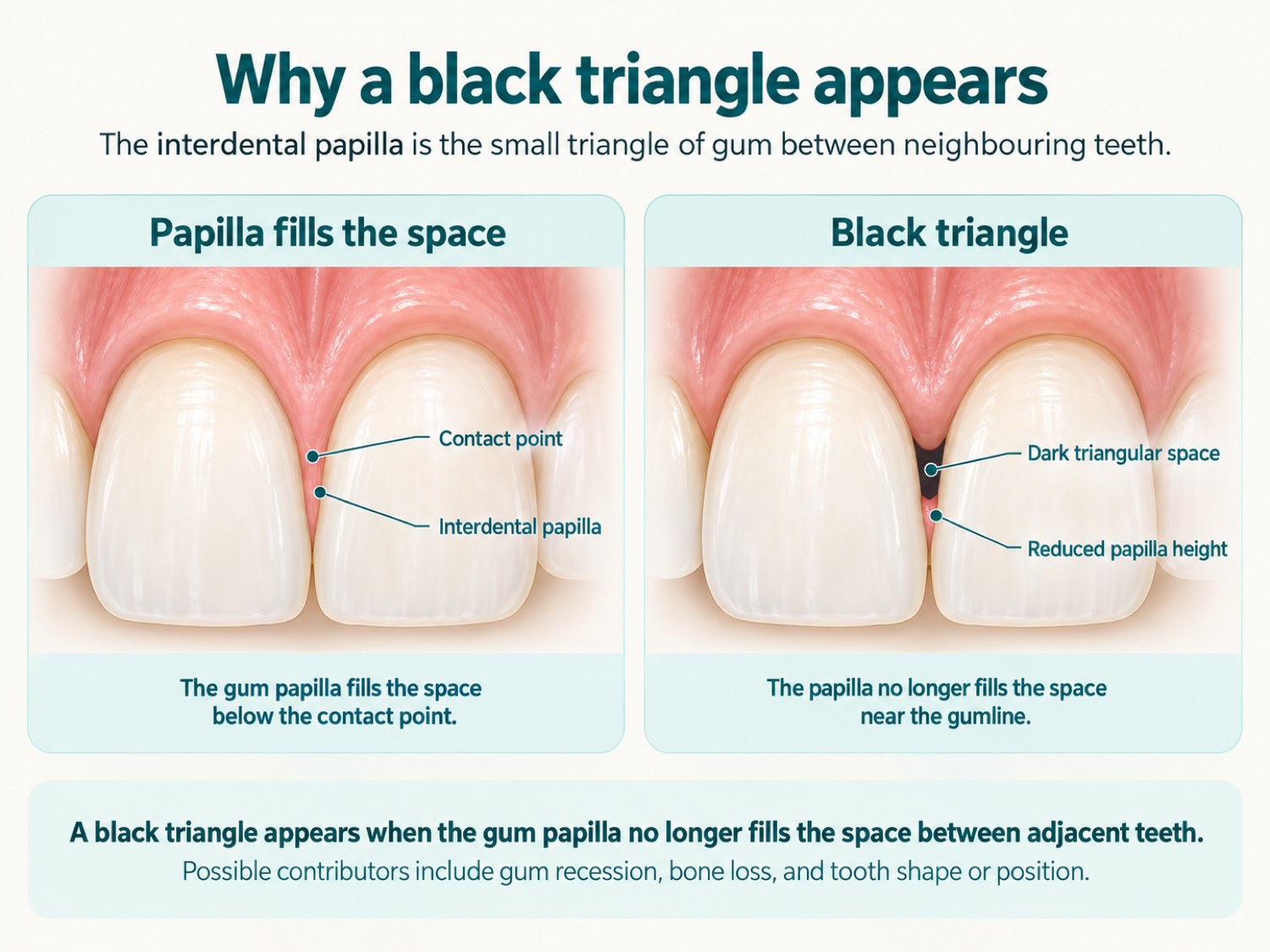
The small triangle of gum that normally fills the space between two teeth is called the papilla. When it shrinks or the bone beneath it recedes, a space opens up and appears dark against the mouth behind it.
Black triangle teeth
Compare the approaches
| Approach | How it closes the space | Tooth structure removed | Reversible? | Typical timeframe |
|---|---|---|---|---|
| Bioclear (composite bonding) | Reshapes the tooth with composite so the contact point sits lower | Usually none or minimal | Largely — composite can be removed or replaced | Often one or two visits |
| Orthodontic closure (Invisalign or braces) | Moves teeth together, sometimes with reshaping of contact points | Minimal, where reshaping is used | Tooth movement is not reversed by stopping | Months, depending on the case |
| Gum and periodontal care | Treats the underlying cause; does not itself close the space | None | Not applicable | Assessed case by case |
Swipe sideways to compare all columns.
About Bioclear at Teeth Q
Bioclear uses clear anatomic matrices and heated composite to shape the tooth around the gumline. It is a defined system with its own instruments and technique, not the same as a standard composite filling.
Composite can stain, chip or wear over time and may need polishing, repair or replacement. Daily cleaning between the teeth remains important, and the gum condition still needs monitoring.
Results depend on the size of the space, gum health, bite and tooth position. Very large spaces may be better addressed with orthodontic treatment first, or may not fully close.
Your assessment and treatment journey
Your dentist examines the gums, bone level, tooth shape, bite and the spaces themselves. X-rays may be recommended to assess the bone supporting the papilla.
You discuss whether the cause is recession, gum disease, tooth shape or alignment, and which approaches are appropriate. Expected results, maintenance and fees are explained.
Where active gum disease or heavy deposits are present, these are managed before cosmetic work, so the result is built on stable tissue.
Bonding is usually completed over one or two visits. You receive cleaning guidance for the treated area and a review plan for the gums and the restorations.
Bioclear fees
Availability
Dr Audrey Chua, Dr Grace Lau, Dr Sherianne Lew, Dr Nadya Neo, Dr Tan Mae Yee, Dr Arthur Liew, Dr Gavin Tsu, Dr Soh May Leng, Dr Krystell Chiu, Dr Tay Min Yi and Dr Emily Tham.
Like Invisalign and Botox, this treatment is practitioner-based rather than offered at every session. Availability varies by clinic and dentist, so book an assessment with one of the dentists listed.
If you are in braces or Invisalign, raise black triangles with your treating dentist. Spaces are often better assessed once alignment is complete.
Common questions
They form when the gum papilla between two teeth shrinks or the bone beneath it recedes. Common reasons are gum recession, gum disease and bone loss, triangular tooth shape, and the unmasking of spaces after orthodontic treatment.
Lost gum papilla does not reliably regenerate. Treatment generally closes the space by reshaping or repositioning the teeth rather than by regrowing gum tissue.
Bioclear at Teeth Q is $200 per tooth. Because a black triangle sits between two teeth, closing one space is $400. The fee excludes GST at clinics where GST applies, and excludes consultation, imaging and any gum treatment needed first.
Often yes. Bioclear composite bonding adds material to reshape the tooth and usually removes little or no tooth structure, unlike crowns or veneers. Suitability depends on the size of the space, gum health and your bite.
It is a specific system rather than a general technique. Bioclear uses clear anatomic matrices and heated composite to shape the tooth around the gumline, and requires particular instruments and training.
Sometimes. Moving teeth closer together, occasionally with reshaping of the contact points, can reduce or close a space. Whether this suits you depends on your alignment, bite and the cause of the space.
Not for the cosmetic treatment itself. CHAS filling subsidies are for clinically necessary fillings, assessed by your dentist against the CHAS claim guidelines, and MediSave is for eligible surgical procedures. Closing black triangles with Bioclear is cosmetic bonding, so neither applies. Gum treatment carried out for dental health reasons is assessed separately.
Composite can stain, chip or wear over time and may need polishing, repair or replacement. Longevity depends on your bite, habits, oral hygiene and gum health. Your dentist will explain what to expect for your case.
Sources and further reading
Oral care, gum disease and age-related dental problems. Read more ↗
Reviewed by Dr Audrey Chua on 7 September 2026. General information here does not replace an individual dental assessment.
Ready for the next step?